
Defence decisions depend on information drawn from many domains. Engineering, logistics, procurement, healthcare, public administration and intelligence all contribute to national security, warfighting capability and operational readiness.
Raedan AI helps Defence organisations establish Semantic Control across this information, then operationalise it through Hybrid AI. The objective is faster intelligence discovery, stronger evidence, better-connected knowledge, and trusted decision support.
Defence is not a single information domain.
Platform and submarine design, engineering, maintenance, shipbuilding, infrastructure, supply chains and sustainment.
Explore Industrial ApplicationsGovernance, regulation, budgeting, procurement, program oversight, workforce planning and sovereign capability.
Explore Public Sector ApplicationsWorkforce health, medical readiness, operational medicine, rehabilitation and veteran support.
Explore Healthcare ApplicationsThreat assessment, intelligence fusion, capability planning, mission readiness, operational risk and strategic decision-making.
The Defence & Intelligence layer sits above these domains. It connects information across them so commanders, analysts, capability managers and decision-makers work from a more coherent operational picture.
AUKUS makes this cross-domain challenge especially visible. Australia’s program spans nuclear-powered submarine design and construction, industrial capacity, workforce, supply chains and advanced capability collaboration. Delivering value from this information requires connections across technical, operational, industrial and strategic contexts.
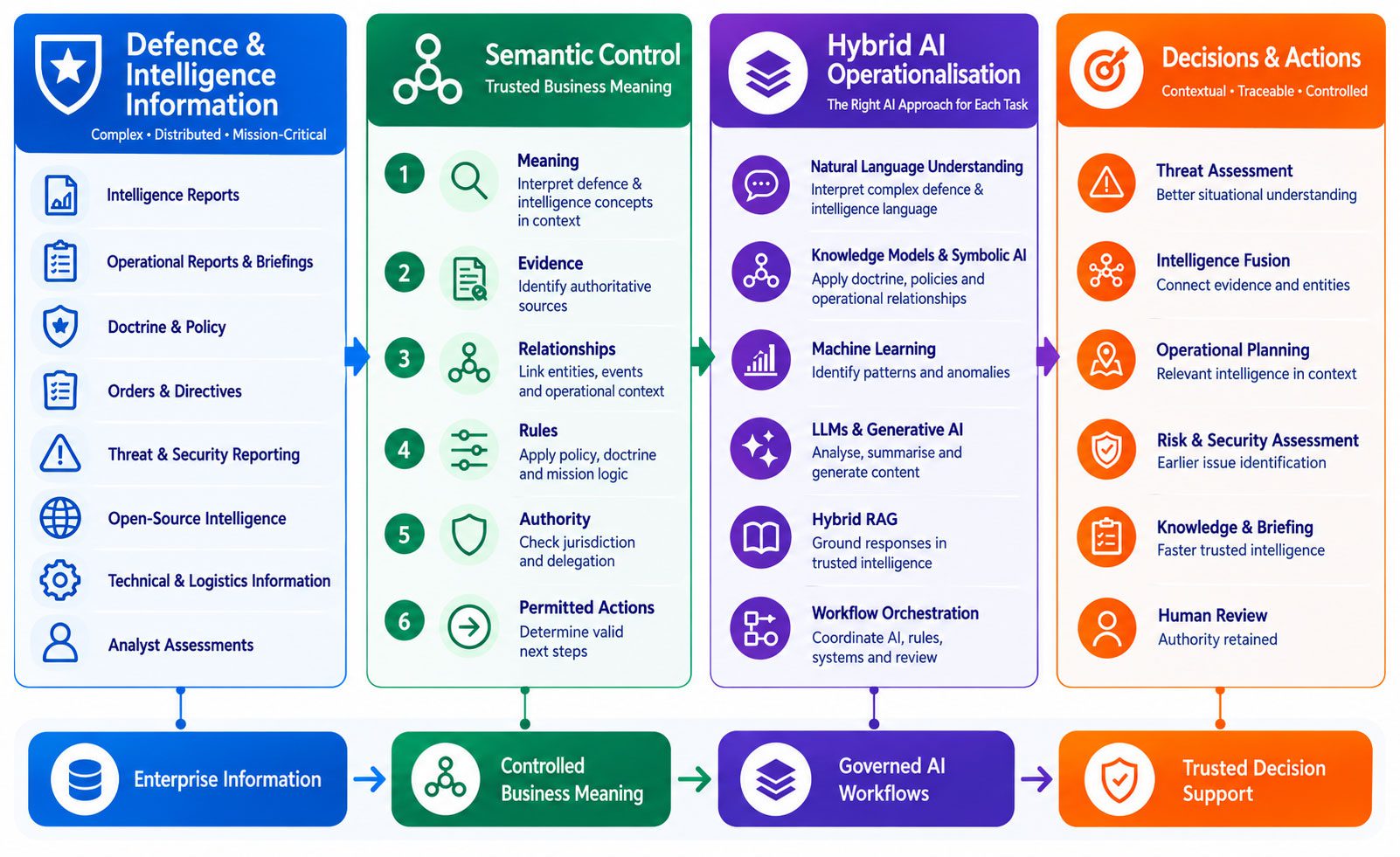
Defence organisations work with complex, distributed and mission-critical information:
The challenge is not simply retrieving more information. It is interpreting information in context and connecting evidence across sources.
Before AI supports a Defence decision, it needs to determine:
Identify the Defence decisions, intelligence requirements and information dependencies where better interpretation creates operational or strategic value.
Define mission concepts, terminology, entities, relationships, authoritative sources, rules, provenance, access conditions and decision boundaries.
Apply these controls through Hybrid AI workflows combining natural language understanding, knowledge models, symbolic reasoning, machine learning, LLMs and human review.
one semantic layer provides shared terminology, entity definitions, evidence standards and escalation logic across all four use cases. Intelligence teams gain consistency without rebuilding context and controls for every application.
Apply a governed threat vocabulary to news, social media and surface, deep and dark web content, identifying relevant intelligence across languages.
Semantic control aligns aliases, acronyms, translations and threat categories around shared definitions. Analysts receive broader coverage with less noise and more consistent alerting.
Resolve people, organisations, locations, assets and events, then map their spatial, temporal and causal relationships across fragmented sources.
Semantic control gives each actor and relationship a governed interpretation across systems. It reduces missed links and false associations while making connections inspectable by analysts.
Transform heterogeneous text, image and video feeds into governed threat indicators, priority alerts and a common operational picture.
Semantic control makes indicator definitions, thresholds, supporting evidence and escalation rules explicit. Decision-makers receive faster warnings with clear grounds for confidence and human review.
Connect authoritative evidence about technologies, materials, components, suppliers and defence systems to assess dependencies and support strategic foresight.
Semantic control preserves common definitions, source authority, relationships and provenance throughout the assessment. It supports consistent prioritisation and defensible briefings while keeping final judgement with intelligence professionals.
Defence information does not have one universal meaning. Interpretation depends on mission context, source reliability, relationships, time, authority, classification and intended use.
Semantic Control provides the layer between information and AI where these distinctions are made explicit.
It supports:
Raedan AI combines Defence information strategy, governance and semantic architecture with expert.ai’s Hybrid AI technology. This follows the broader Raedan AI model of moving from information strategy through governance and semantic architecture into controlled operational AI.
The goal is not autonomous decision-making.
It is to give analysts and Defence decision-makers stronger control over how AI interprets information, connects evidence and surfaces relevant intelligence.
If analysts still spend significant effort reconciling fragmented reports, terminology, evidence and sources, the constraint is not simply access to AI.
It is whether Defence has established the shared meaning and controls needed to fuse information reliably across domains.
