

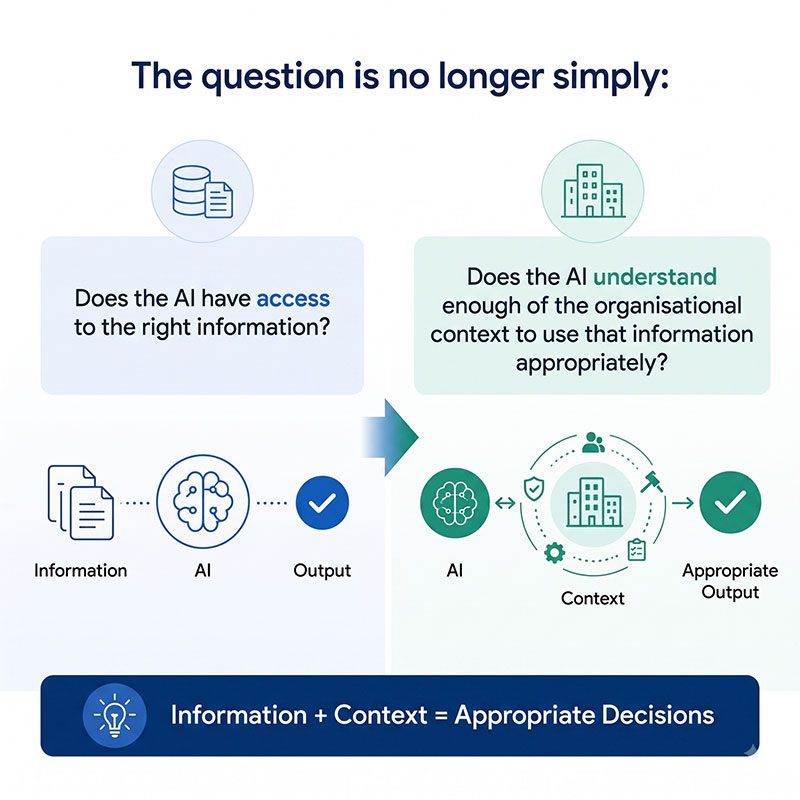
Most organisations already have established governance disciplines.
Data governance addresses data ownership, quality, access, metadata, lineage and accountability.
Information governance addresses the management, use, retention and authority of information.
AI governance addresses the risks, responsibilities and acceptable use of artificial intelligence.
All are necessary, but a gap remains between them.
AI needs organisational context in a form that machines use consistently. Definitions, relationships, classifications, policies and business rules often remain distributed across glossaries, documents, systems, databases and the knowledge of experienced staff.
Semantic Control addresses this gap by making organisational meaning explicit, governed and usable by AI.
The underlying principle is not new. Information Engineering emerged in the 1980s from recognition that organisations should design information around the needs of the enterprise rather than individual applications.
Information Engineering Planning started with the business: its objectives, activities, information requirements, entities and relationships. Technology followed.
As enterprise technology evolved, elements of this discipline became distributed across enterprise architecture, data architecture, metadata management, master data management, records management and data governance.
AI brings the original principle back into focus.
If AI is expected to interpret enterprise information, support decisions and eventually undertake actions, the organisation needs an explicit understanding of the information environment in which AI operates.
The principle remains:
Start with the Business. Define its Information and Meaning. Then Apply Technology.

This requirement is increasingly reflected in mainstream industry research.
Gartner stated in a May 2026 press release that AI agents depend on context, including semantic representations of organisational data, relationships and rules.
Gartner warns that neglecting semantic foundations increases the risk of inaccurate agents, wasted expenditure and governance vulnerabilities.
Its recommendation is significant: organisations should establish a context layer as part of their data and analytics infrastructure.
McKinsey reaches a similar conclusion in its work on agentic AI architecture. One of its core principles is to “share meaning, not just data.” It describes a semantic layer between data and AI applications that represents business meaning in machine-readable form, supported by ontologies, knowledge graphs, metadata and governance.
IBM similarly describes semantic layers as an architectural mechanism for translating complex data into meaningful business terms while standardising definitions, relationships and business logic.
The terminology differs, but the architectural direction is increasingly consistent:
Enterprise AI Requires Governed Business Context as well as Governed Data.
Semantic Control establishes a governed layer between enterprise information and the AI systems using it.
It brings together six elements:
Semantic Control does not replace data governance, information governance, enterprise architecture or AI governance.
It connects them at the point where information becomes interpretation and interpretation becomes action.

Without shared semantic control, each AI solution risks reconstructing business context independently. Different applications might use different definitions, retrieve different sources, apply different assumptions or interpret the same policy differently.
This becomes difficult to govern as AI adoption expands. Semantic Control changes the architecture. Business meaning becomes a reusable enterprise capability rather than something embedded separately within every AI application.
AI models and agents operate against governed definitions, relationships, authoritative sources, rules and controls. The objective is not to remove probabilistic AI or force every decision into deterministic rules.It is to determine where AI has freedom to interpret and where the enterprise requires control That distinction becomes increasingly important as AI moves from answering questions to supporting decisions and taking actions.
Your organisation already governs systems, data, access and business processes.
As AI increasingly interprets information and acts on your behalf, who governs what your information means?
Semantic Control reflects a broader industry shift towards governed context, semantics and knowledge as foundations for enterprise AI
