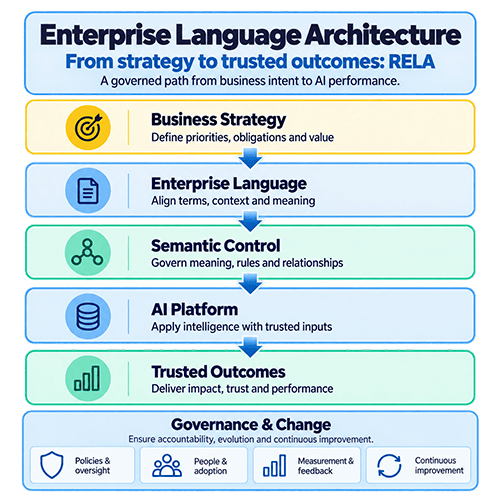
The Raedan Enterprise Language Architecture (RELA) provides a structured architecture for governing organisational meaning from strategic intent through operational AI.
RELA connects business strategy, enterprise information requirements, shared business language, semantic control, AI platforms and business outcomes. It complements enterprise architecture, data governance, information governance and AI governance. Its purpose is not replacement. Its purpose is connection and to increase the value of investing in AI at scale.
As AI takes on a larger role in interpreting information, supporting decisions, and executing workflows, organisations need a consistent way to express business meaning in forms that people, systems, and AI can use reliably.
RELA treats Enterprise Language as a strategic enterprise capability and Semantic Control as the mechanism for governing its use.
Defines objectives, decisions, obligations, priorities and executive intent.
This layer identifies where information and AI create business value, which decisions depend on trusted information, and where stronger control is required.
Defines shared business concepts, terminology, definitions and relationships.
Typical assets include business information models, governed vocabularies, taxonomies, ontologies, concept models and dictionaries. Together, these assets provide a reusable representation of organisational meaning across people, processes, systems and AI.
Governs how enterprise meaning is interpreted and applied.
Semantic Control brings together six core elements:
It connects business language with authoritative information, policy, business logic, provenance and decision boundaries.
Operationalises governed meaning through appropriate technology.
Components include Hybrid AI, symbolic reasoning, machine learning, large language models, RAG, vector retrieval, knowledge models, agents, orchestration and enterprise applications.
RELA remains technology independent. The architecture defines the business meaning and the required controls. Technology implements them.
Measures impact in decisions, compliance, productivity, risk, trust and operational performance.
Outcomes feed back into strategy, enterprise language and governance. RELA therefore operates as a continuous enterprise cycle rather than a one-time architecture exercise.
Using modern Information Engineering Planning principles, we identify where trusted information and consistent meaning matter most, and then define the required semantic capabilities.
Key Outputs:
RELA provides the organising architecture for operating concepts, relationships, authoritative sources, rules, evidence requirements, decision boundaries, stewardship and change control.
Key Outputs:
Knowledge models, symbolic rules, natural language understanding, retrieval, LLMs, workflow orchestration, human review, provenance, monitoring, and integration build end-to-end business solutions.
Raedan AI uses expert.ai technology for tailored Hybrid AI.
Key Outputs:
Every important business activity relies on language. Policies, legislation, contracts, records, procedures, data and professional knowledge all describe how an organisation operates.
When definitions differ across business areas, systems and documents, AI inherits those differences. Repeated local interpretation leads to inconsistent outputs, duplicated semantic work, and weak governance.
RELA treats Enterprise Language as a governed enterprise asset. Shared concepts, definitions and relationships become reusable foundations for staff, systems, analytics, AI and agents.
Governance, Security, Assurance and Change Management operate across every RELA layer. They establish ownership, stewardship, quality, access, traceability, auditability, version control, monitoring and controlled evolution of enterprise meaning.
Adherance to RELA Architectural Principles and the cross-cutting approach keeps business meaning aligned as policies, regulations, organisational structures, technology and operating requirements change.
RELA creates a stronger foundation for AI adoption by connecting strategic intent with governed enterprise meaning.
Benefits include more consistent decisions, stronger regulatory compliance, greater reuse of knowledge, clearer traceability, and better alignment of business and technology.
RELA establishes shared semantic capabilities across multiple use cases. AI initiatives no longer rebuild terminology, retrieval logic and evidence controls independently. Implementation is faster and proven more cost-effective,
The objective is to govern meaning at enterprise scale, supporting people, systems, and AI with a consistent foundation for decisions and action.