
AI accesses more enterprise information than ever. Reliable decisions still depend on meaning, evidence, relationships, rules, authority and permitted actions. Semantic Control provides the governed layer between enterprise information and AI.
Generative AI has transformed access to knowledge and natural-language interaction. It has also exposed a deeper weakness in enterprise AI:

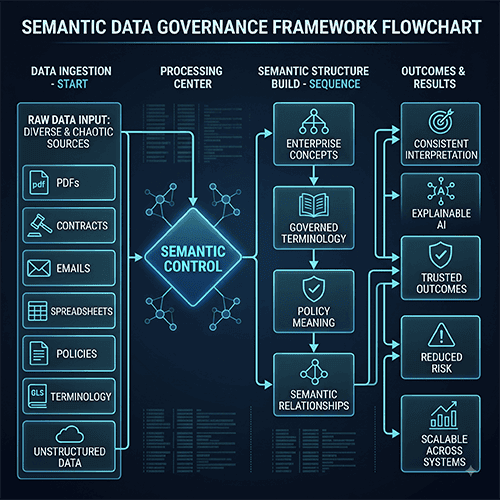
AI uses information created for people, processes and applications. It encounters conflicting terminology, fragmented authority, and undocumented rules and relationships spread across documents and systems.
Without control over meaning, AI amplifies inconsistency. It retrieves information, but remains unable to determine which interpretation applies, which source carries authority, what evidence supports an outcome, or which action is permitted.
Semantic Control addresses this enterprise meaning gap.

Semantic Control is an enterprise capability for defining, governing and applying meaning across information, AI systems and business decisions.
It makes concepts, relationships, evidence, rules, authority and permitted actions explicit, reusable and traceable. AI and agents then work within refined context rather than relying only on statistical likelihood.
Semantic Control supports sound data governance, information management, AI governance and security. It connects them where meaning becomes interpretation, decision and action.

AI uses information created for people, processes and applications. It encounters conflicting terminology, fragmented authority, and undocumented rules and relationships spread across documents and systems.
Without control over meaning, AI amplifies inconsistency. It retrieves information, but remains unable to determine which interpretation applies, which source carries authority, what evidence supports an outcome, or which action is permitted.
Semantic Control addresses this enterprise meaning gap.

AI uses information created for people, processes and applications. It encounters conflicting terminology, fragmented authority, and undocumented rules and relationships spread across documents and systems.
Without control over meaning, AI amplifies inconsistency. It retrieves information, but remains unable to determine which interpretation applies, which source carries authority, what evidence supports an outcome, or which action is permitted.
Semantic Control addresses this enterprise meaning gap.
Underwriting, claims, policy comparison, risk engineering and regulatory processes.
Explore applicationsAML, customer screening, regulatory change, knowledge services and ESG risk.
Explore applicationsClinical trial intelligence, scientific evidence, submission readiness and regulatory documentation.
Explore applicationsClinical language, coding, records, privacy, knowledge access and decision support.
Explore applicationsInformation exploitation, entity and relationship analysis, open-source intelligence and controlled knowledge services.
Explore applicationsPolicy interpretation, regulatory services, casework, correspondence, records and citizen guidance
Explore applicationsIndustrial organisations depend on complex engineering, maintenance, safety and operational information. Semantic Control, operationalised through Hybrid AI, turns this fragmented documentation into trusted risk and performance intelligence for safer, more consistent and evidence-based decisions.
Explore applicationsexpert.ai combines symbolic reasoning, natural language understanding, knowledge graphs, machine learning and large language models. This Hybrid AI approach supports governed, explainable applications rather than unrestricted automation.
Technology appears after the business problem, control model and architecture are clear — a practical foundation for governed understanding and faster operational value.
Explainable outcomes — every decision traceable to evidence, rules and authority.
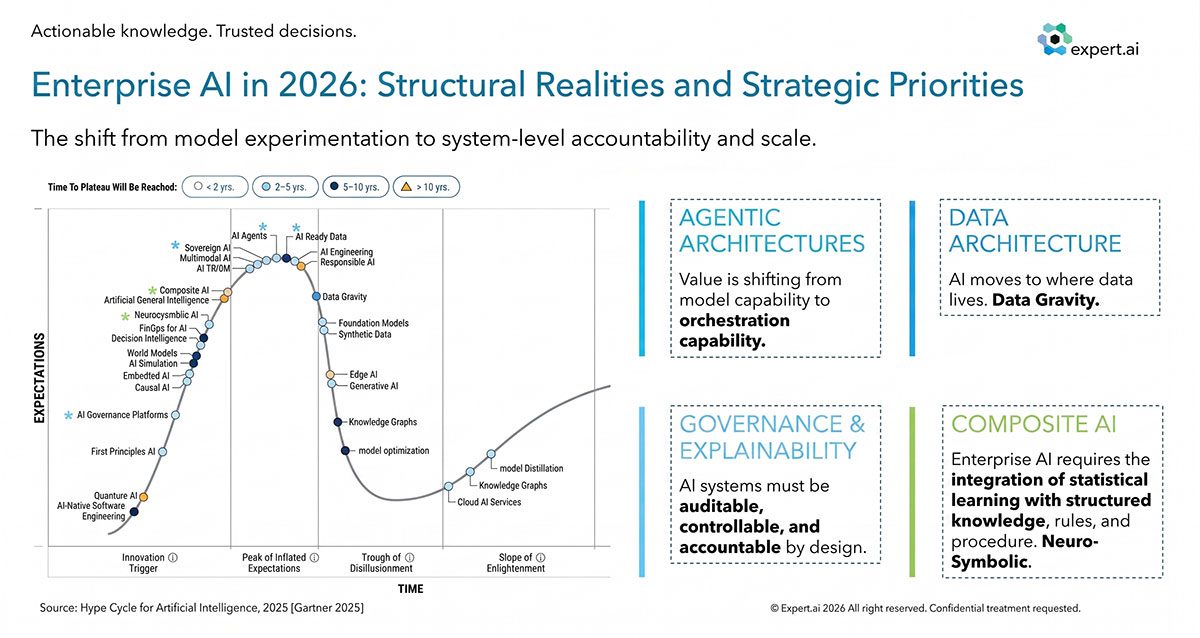
Explore how symbolic AI, knowledge graphs, rules, machine learning, LLMs and integration services work together within a Hybrid AI architecture.
Review the platform capabilities used to build, govern and operate knowledge-intensive AI applications across enterprise environments.
Pre-engineered deployment patterns for defined business processes — domain knowledge, semantic models, workflow automation and Hybrid AI controls.
Case studies show how organisations apply semantic understanding, knowledge models and Hybrid AI to improve complex, information intensive work. Explore outcomes across regulated industries, from faster document review and stronger knowledge access to controlled risk and compliance processes.
Our Thinking section examines strategic, governance and architectural implications through white papers, research, architectural notes and executive articles.
Topics include Enterprise Language Architecture, semantic governance, Hybrid AI, agentic AI control, information engineering, AI assurance and the design of enterprise meaning.
| Audience | Recommended Route |
|---|---|
|
Senior Executives |
Start with Why Semantic Control, then How We Help. |
|
Information & Governance Leaders |
Start with What is Semantic Control, then RELA Architecture. |
|
Enterprise & AI Architects |
Start with RELA Architecture, then Technology. |
|
Capability & Use-case Leaders |
Start with Applications, then Case Studies. |
A focused discussion will identify the decision, information dependencies and controls worth addressing first.
