
For organisations operating at enterprise scale, the challenge is rarely access to information. The challenge is ensuring that AI systems consistently interpret information correctly, apply business context appropriately, and produce outcomes that can be trusted.
expert.ai combines symbolic AI, knowledge-based reasoning, machine learning and large language models to deliver AI applications that are accurate, explainable and aligned to business objectives. The result is AI built for decision-making, not simply content generation.
Regulated organisations face a different AI problem.
AI can no longer be limited to retrieving information, generating an answer, or automating a task. As AI becomes embedded in decisions and operational processes, organisations need to know:
These requirements change the architecture required for enterprise AI.
They are also why Raedan AI believes expert.ai should be a mandatory consideration when regulated organisations evaluate AI for knowledge-intensive, decision-intensive or agentic processes.
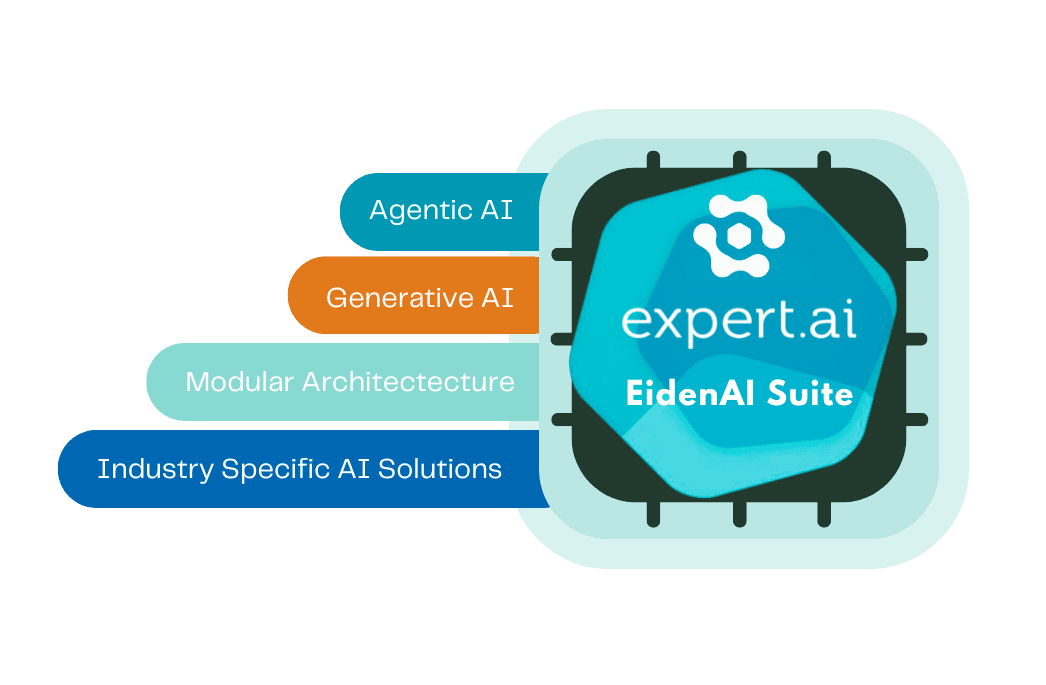
Gartner research points towards a new enterprise AI architecture. Their 2026 research increasingly separates enterprise-grade AI from AI built primarily around generative models.
Its research into agentic AI, Composite AI, neurosymbolic AI, and knowledge graphs points to several recurring requirements: governed context, explicit knowledge, traceability, multiple AI techniques, domain-specific models, and stronger control over autonomous systems.
Gartner’s Neurosymbolic AI, a Shortcut to Agentic Systems Governance states that enterprise architecture leaders should use neurosymbolic AI to better train, observe, control and orchestrate AI agents. Gartner also highlights industry-specific use cases, ontologies, cognitive frameworks and knowledge bases as important foundations for scaling agentic systems.
In healthcare and life sciences, Gartner argues that knowledge graphs provide the grounding, context and traceability required to move agentic AI towards reliable higher-autonomy systems.
In banking, Gartner’s emerging architecture goes further. Its G.U.I.D.E. framework addresses the context an agent receives, the route it selects, the services it invokes, the actions it completes and the evidence retained.
The direction is significant.
Enterprise AI is moving from generating plausible answers towards operating within governed systems of meaning, knowledge, rules, evidence and authority.
Expert.ai introduces a semantic control layer between enterprise knowledge and AI reasoning — providing meaning, structure and governance so AI recognises not only words but also concepts, relationships, context and business intent.

Enterprise decisions depend on meaning. Consider the term “Exposure” — its meaning differs significantly across:
Risk of financial loss on a policy
Credit or market risk position
Patient exposure to a substance or pathogen
Worker safety exposure to hazards
Worker safety exposure to hazards
The challenge is not simply finding or summarising content. It is determining what the information means within the relevant legislative, policy, operational and jurisdictional context.
A semantic architecture captures these distinctions. Rather than relying solely on statistical probability, expert.ai incorporates industry-specific knowledge into the decision process — delivering greater precision, consistency and explainability.
Many AI platforms start with a model. expert.ai starts with understanding.
This creates a Hybrid AI architecture that combines the strengths of each approach while mitigating their limitations.
The platform combines:
Identifies concepts, entities, relationships and context.
Connects information across systems and domains.
Applies organisational policies and constraints.
Learns patterns from data.
Provide natural language interaction and generative capabilities.
As AI moves from experimentation to operational deployment, governance becomes a business requirement. Organisations increasingly need to answer:
Expert.ai was designed for these requirements from the outset, providing greater transparency into how information is interpreted, linked and applied to business processes.
RAG improves access to information — it does not necessarily improve understanding. A semantically aware architecture helps organisations move beyond document retrieval toward:
The goal is not simply finding information. The goal is making better decisions.
Many organisations already use AI for search, summarisation, chat assistants and content generation. These provide valuable productivity benefits.
Expert.ai enables a different class of outcomes.
Interpret regulations, policies and obligations consistently across the organisation.
Identify emerging risks across large volumes of structured and unstructured information.
Connect information across multiple interaction channels and business systems.
Extract, classify and evaluate information from complex insurance documents.
Identify relationships across research, clinical, and regulatory information.
Transform enterprise knowledge into operational decision support.
From productivity tools to trusted decision intelligence.
Designed for Real-World Deployment
Enterprise AI must operate within existing environments. expert.ai is designed to integrate with:
This allows organisations to enhance existing investments rather than replace them.
Most AI initiatives begin with improving individual productivity. The greatest business value emerges when AI becomes part of operational decision-making. This requires:
Understanding the business situation and relevant constraints.
Controls that ensure AI operates within defined boundaries.
Clarity on why a recommendation or decision was made.
The same interpretation applied across instances and systems.
A clear path from output back to source information and reasoning.
These capabilities depend on understanding meaning, not simply generating language. That is why semantics remains a foundational requirement for enterprise AI.
Industry-specific AI applications and solutions built for regulated and knowledge-intensive environments.
Ready-to-deploy solutions that accelerate time-to-value for specific business challenges.
If your organisation is moving beyond experimentation and into enterprise-scale AI adoption, architecture matters. Discover how symbolic AI, Hybrid AI and explainable decision intelligence help organisations achieve outcomes that are difficult to deliver through LLMs alone.
