Enterprise AI eventually encounters information where interpretation matters.
LLMs are powerful at language generation and interpretation, but enterprise decisions require more than plausible interpretation. They require controlled business meaning.
Without this capability, each AI solution risks developing its own prompts, retrieval logic, terminology, rules and interpretation of enterprise information.
The result is fragmented AI rather than enterprise AI.
The purpose of Semantic Control for AI is simple:
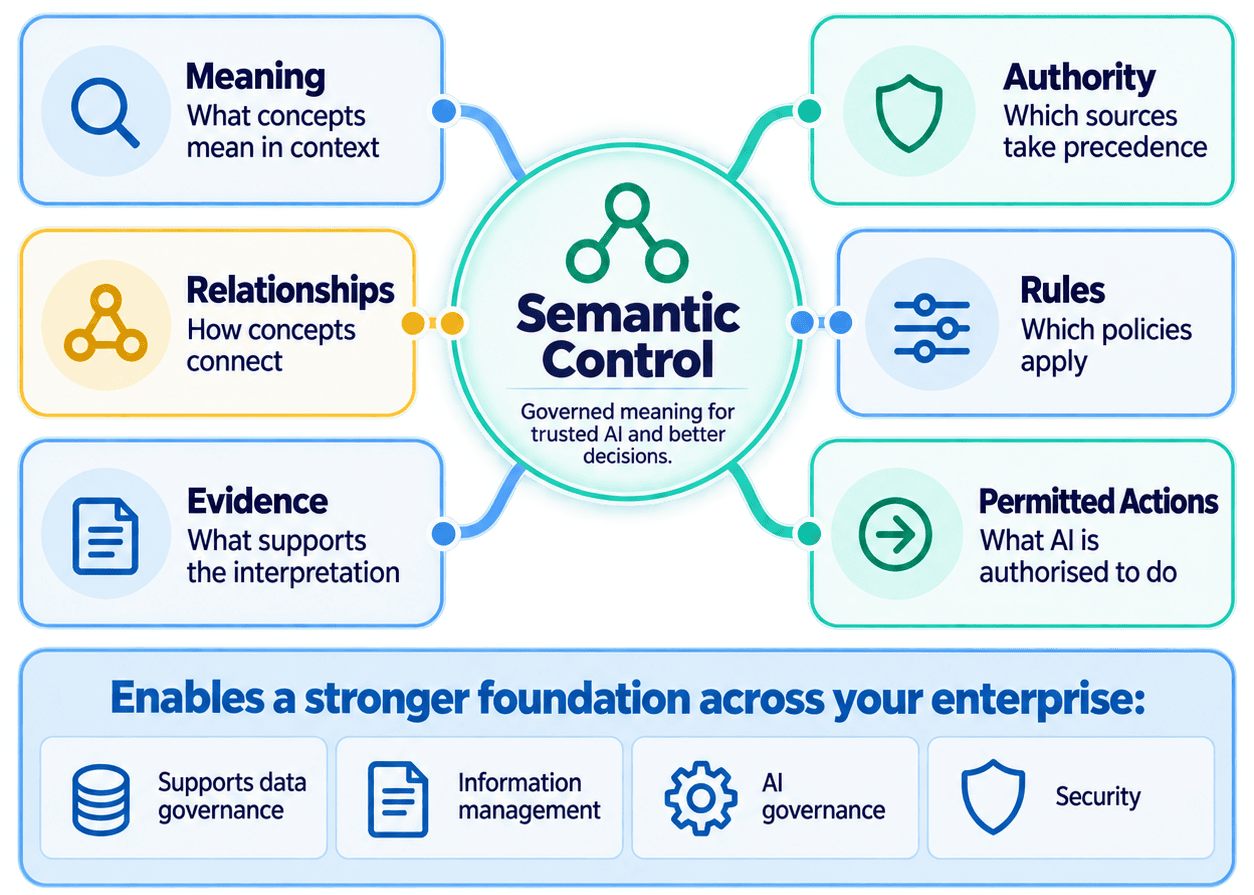
Ensure AI uses the organisation’s meaning, evidence, relationships, rules and decision boundaries rather than predicting them independently.
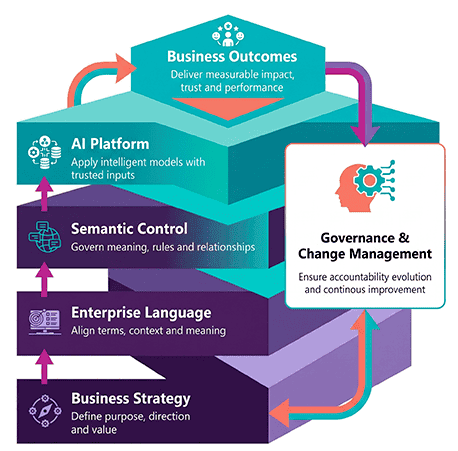
Semantic Control does not replace your existing architecture. It integrates and extends it.
Semantic Control brings these capabilities together around one objective: govern how enterprise meaning moves from information into decisions and actions.
Enterprise AI strategy beginning with the easiest use case to automate creates downstream roadblocks. Shift to where the language is most complex and where an incorrect result has greater business consequence. This will surface resource heavy and costly processes such as:
These examples will expose the semantic capabilities the enterprise needs. A sequence of isolated bottom-up pilots often optimises individual tasks without resolving the harder enterprise problem: how the organisation defines and controls meaning consistently across AI.
The better question is: What semantic capability must we establish so our most demanding AI use cases work reliably?
Successful enterprise AI needs a suite of skills and tools
Semantic Control provides the foundation for moving from isolated AI solutions to governed enterprise AI.
An LLM platform may have Guardians or best-practice RAGs, but that does not assure results are consistent or repeatable.